

Problem Solving
Quant
12 min readThe GMAT Quantitative section tests fundamental arithmetic concepts that form the basis of more advanced mathematical reasoning. A strong grasp of the number system, operations, and properties is essential for solving problems efficiently. This guide provides an in-depth exploration of core arithmetic topics, including the number system, integers, fractions, decimals, exponents, and roots, with practical GMAT-style examples to reinforce understanding.
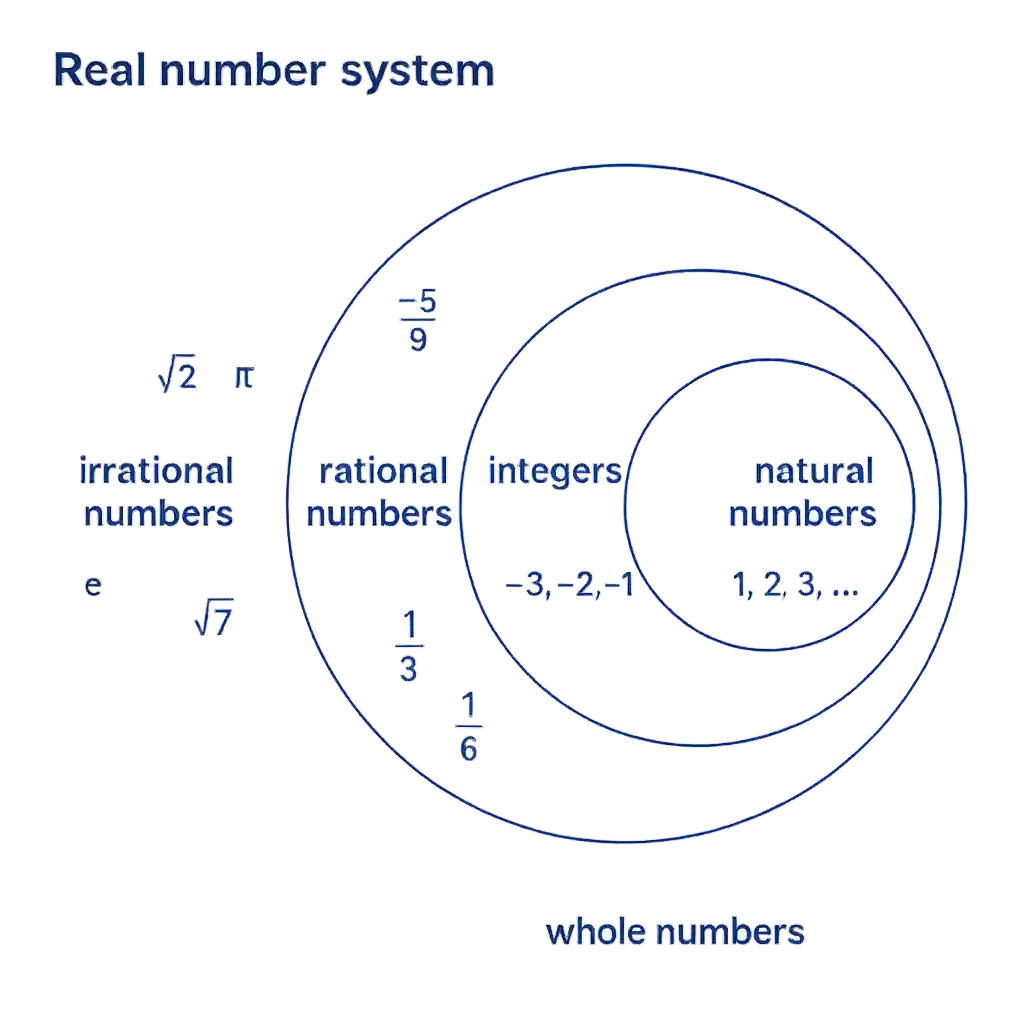
Definition: The set of numbers used for counting discrete objects: {1, 2, 3, ...}
Key Characteristics:
GMAT Applications:
Definition: Natural numbers extended to include zero: {0, 1, 2, 3, ...}
Key Characteristics:
GMAT Applications:
Definition: The set of positive and negative whole numbers including zero: {..., -2, -1, 0, 1, 2, ...}
Key Characteristics:
GMAT Applications:
Definition: Any number expressible as a ratio a/b where a and b are integers and b ≠ 0
Key Characteristics:
GMAT Applications:
Definition: Real numbers that cannot be expressed as ratios of integers
Key Characteristics:
GMAT Applications:
Definition: The complete set of rational and irrational numbers

Key Characteristics:
GMAT Applications:
Problem Statement:
If x is an integer greater than 1 but less than 5, and y is a non-integer between 2 and 3, what is the sum of the largest possible value of x and the smallest possible value of y?
Detailed Solution:
Key Takeaways:
While addition, subtraction, multiplication, and division seem elementary, the GMAT tests sophisticated understanding:
Advanced Example: "If 7 × (3 + x) = 7 × 3 + 7 × 5, what is x?" This directly tests the distributive property.
The standard order is Parentheses/Brackets, Exponents/Orders, Multiplication-Division (left to right), Addition-Subtraction (left to right). Common GMAT traps involve:
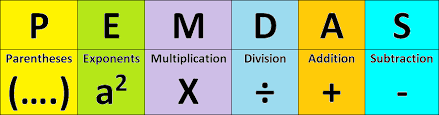
Complex Example: Evaluate: 5 + 3 × 2³ - (8 ÷ (4 - 2)) × 2
Step-by-step solution would show proper order application.
Understanding proper, improper fractions, and mixed numbers forms the foundation of fractional arithmetic:
Improper to Mixed Number Conversion:
Process: Divide numerator by denominator, use quotient as whole number and remainder as new numerator.
Example: Convert to mixed number:
Mixed Number to Improper Fraction:
Process: Multiply denominator by whole number, add numerator, keep original denominator.
Example: Convert to improper fraction:
The key to adding or subtracting fractions lies in finding a common denominator. For algebraic fractions, this requires factoring:
Numerical Example:
Compute
Algebraic Example:
Simplify
For multiplication, simplify before multiplying to reduce computation. For division, multiply by the reciprocal.
Multiplication Example:
Compute
Division Example:
Compute
Memorizing common decimal-fraction conversions saves valuable time on the GMAT:
| Fraction | Decimal | Percentage |
|---|---|---|
| 0.125 | 12.5% | |
| ≈0.1667 | ≈16.67% | |
| 0.2 | 20% | |
| 0.375 | 37.5% | |
| 0.4 | 40% | |
| 0.625 | 62.5% | |
| 0.6 | 60% | |
| 0.875 | 87.5% |
Conversion Techniques:
To convert any fraction to decimal:
GMAT frequently tests number sense through approximation questions:
Example Problem:
"Which value is closest to ?"
Estimation Strategies:
These problems test understanding of successive percentage changes:
Classic Example:
"A product's price is discounted by 20%, then the discounted price is increased by 20%. What's the net percentage change?"
General Formula:
For successive percentage changes :
Final multiplier =
Understanding this distinction is crucial for data interpretation questions:
Example Scenario:
"If interest rates increase from 5% to 7%, describe the change:"
Prime factorization is fundamental for solving many number theory problems:
Example Problem:
"How many positive divisors does 72 have?"
These concepts frequently appear in word problems involving repeating cycles:
Word Problem Example:
"Bus A departs every 15 minutes, Bus B every 20 minutes. If they depart together at noon, when will they next depart together?"
GCF Problem:
"What is the largest square tile that can exactly cover a 24-inch by 36-inch floor?"
When answer choices are provided, plugging them in can be more efficient than solving algebraically:
Example:
"If , what is x?"
Options: A) 3 B) 4 C) 5 D) 6 E) 7
Advanced Application:
"Which value satisfies ?"
Options: A) -5 B) -2 C) 1 D) 3 E) 5
Particularly useful for data sufficiency and approximation questions:
Numerical Estimation:
Calculate
Percentage Estimation:
"What is 18.3% of 489?"
Being aware of these frequent pitfalls can prevent careless errors:
1. If is the prime factorization of a number, how many total divisors does it have?
Solution: Using the divisor formula: (3+1)(2+1)(1+1) = 4 × 3 × 2 = 24 divisors
2. A shirt's price increases by 30%, then decreases by 30%. What's the net percent change?
Solution: Let original = $100 → $100 × 1.3 = $130 → $130 × 0.7 = $91 → 9% decrease
3. Simplify:
Solution: Numerator: 0.125 × 8 = 1; Denominator: 0.25 × 4 = 1 → 1/1 = 1
4. What is the units digit of ?
Solution: Find each component's units digit:
: 3, 9, 7, 1 → 1
: 7, 9 → 9
: 9, 1, 9 → 9
Final multiplication: 1 × 9 × 9 = 81 → units digit 1
5. If , which could be x? (Options: A) 0.25 B) 0.35 C) 0.45 D) 0.55)
Solution: Convert bounds to decimals: 0.333... < x < 0.5 → Only B) 0.35 falls within range
True GMAT arithmetic mastery requires developing mathematical intuition through:
Final Study Recommendation:
Regular practice with varied problems is essential. Focus on:
Free Problem Solving questions on this topic — try a few now.